


Organizational Change: How Responsive is Your Company? [Infographic]
The thought of organizational change can scare even the most accomplished leaders. But it can also create a feeling of insecurity for everyone else in the organization.
So the question becomes: How ready is your organization for real change?
Organizational Change: The Darwin Approach
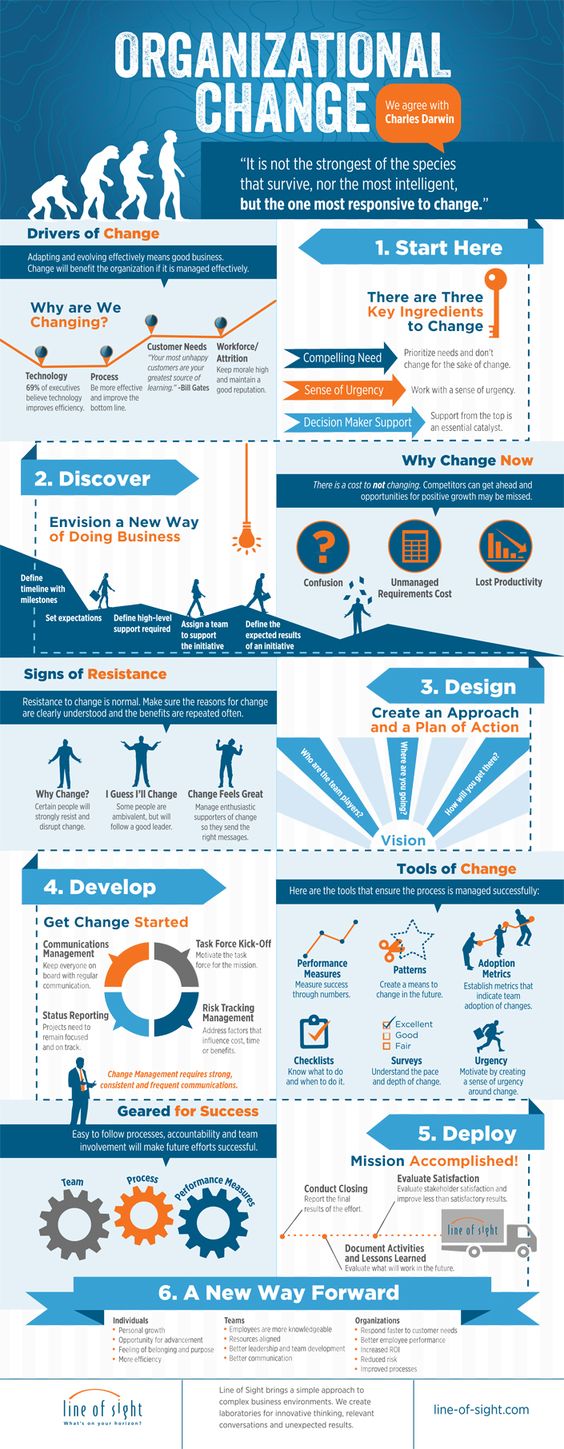
To simplify the thought of organizational change, and to apply the Darwin approach to make change a little less scary, we present this infographic from Line-of-Sight and the Newberry Group.
Here, you’ll learn about the drivers of change as well as the three key ingredients to change. You’ll also come to understand the high cost of not changing, which certainly creates a certain sense of urgency. Next, you’ll learn about how change starts and the tools you might need along the way. Finally, learn more about the deployment of change and how to measure impact and success.
The reason we love this infographic is the simple approach to change. After all, change itself doesn’t have to be complicated. But we must make sure that our leaders and employees are responsive to the idea of change in the first place. Then, as the leaders of change, we must help them understand the “why” before we dive into the “what” and “how.”
Take a look. Think like Darwin. And then decide how responsive your organization is to change.





 When I was in college, the president of our university, Steven Sample, spoke to one of my classes and shared a tip I will never forget. He told us, “In your lifetimes, you will have five to six different careers. Not jobs, but careers.” His underlying message was that change is inevitable, and to succeed professionally you need to develop a broad-based skill set that is transferable.
 As startups grow, it’s inevitable that people’s roles will change. When my company grew from four people to 10 over the span of six months, there was an enormous amount of uncertainty and transition. But through honest conversations — we call them “courageous conversations” — with all of my employees, we were able to find the right roles to set up every employee for success.
 It’s very easy to say yes to meetings and small tasks throughout the week. But all these little tasks and scheduled meetings add up and become death by a thousand cuts. In the latter half of this year, I implemented meeting days on only two weekdays — rarely more — and this has allowed me to capitalize on the “mental mode” I need to be in to get more done on those days.
 Sometimes, after months spent building a challenging product, it can seem like the light at the end of the tunnel will never come. In these darkest moments — when the gratification of customer feedback and revenue hasn’t yet happened — it’s crucial to revive your team’s belief by reminding them of your “why”. For us, it’s creating a never-before-seen piece of tech to reinvent our industry.
 There are many types of boards, but the best are your champions. They only get in the way when you are doing something stupid. So when our board saw we were launching too many products at once without the capital to do so, they encouraged us to go with the most valuable one, and shift the rest of our company toward consultancy and publishing. The results have been fantastic.
 After launching a brand new venture and getting flooded with leads, I was running ahead of the steamroller trying to pick up every quarter. This is clearly a plan that will end in disaster. You can’t sacrifice your process to chase every lead. As soon as I stepped back, I was able to take a look at the leads objectively and figure out a process to better qualify them and quantify them.
 During a rough patch in our growth, we went through every aspect of the company and made massive changes to improve, which has drastically helped our efficiency and profits. Change should be a part of the culture: If something doesn’t work, employees should not be scared to scrap it and go in a different direction.
 When my side business started taking off, I’m ashamed to admit it took me over a year before I finally quit my day job. I loved my job, I loved the friendships I built, and I couldn’t bring myself to leave it all behind. Here’s my plan that finally helped force me to cut loose: Setting a deadline three months in advance and giving notice, and booking a trip starting the day after the deadline.
 We decided to split our long-time Silicon Valley office into three offices: San Francisco, San José and Provo. This was a seismic shift that, at times, was difficult. The lesson: Don’t be afraid to make radical changes in how you run your company. We work differently now, but the flexibility opened other doors — shorter commutes, lower cost of living, a bigger house or even better choice of schools.
 Most entrepreneurs will tell you to trust your gut. While I believe that as well, the data scientist in me says decisions need to be backed up with empirical evidence. If someone says they can do something, ask for proof or talk to past clients. If you can, optimize everything scientifically and verify results. It may seem like a lot of work, but it will save you time and a lot of money, too!
 There is significant political and legislative risk associated in the law practice. Our firm has branched out our practice into areas such as business and risk consulting, as well as venture investing. Our struggle was staying engaged with the base operations that serve as the foundation of the firm. Shifting focus and adding revenue streams is vital, but never forget to stick with the basics.

